
People behind the history
The Thalidomide tragedy
Today, people affected by Thalidomide are senior citizens. They were born between the late 1950s and early 1960s with shortened arms and legs or other deformities. This foetal damage was caused by drugs that contained the active ingredient Thalidomide. According to estimates, around 10,000 so-called ‘Thalidomide babies’ were born worldwide, with around half of them dying at birth or shortly afterwards.1 Thalidomide was a popular sleep aid and sedative developed by the German pharmaceutical company Grünenthal. It was available worldwide under various names in more than 40 countries. The medication was also taken by pregnant women to treat morning sickness after doctors observed a positive effect. This made the drug's teratogenic effect particularly disastrous. At the end of 1961, German paediatrician Widukind Lenz was the first to establish a link between malformations and the use of Thalidomide during pregnancy. Twelve days after Lenz first raised the issue, Grünenthal withdrew the drug from the market.
Thalidomide was one of the most popular sleeping aids of its time
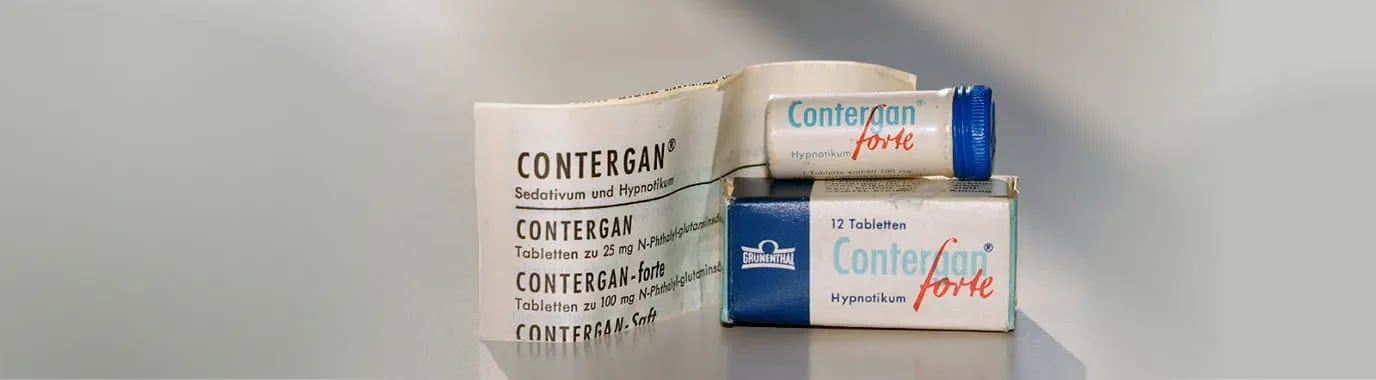
The active substance Thalidomide – a sleep aid and sedative – was developed by the German pharmaceutical company Grünenthal. From 1957 onwards, medicines containing Thalidomide were available in more than 40 countries worldwide under different brand names, including Contergan (Germany), Softenon (Austria and Switzerland and others) or Distaval (United Kingdom, Australia and others). It quickly became one of the most popular sleeping aids of its time: in Germany alone, around 300 million daily doses were sold between 1957 and 1961, and approximately five million people took the drug.
Grünenthal scientists Dr Wilhelm Kunz and Dr Herbert Keller first synthesised Thalidomide in early 1954 – rather by chance as a by-product of their research into glutamic acid.
At the time, Grünenthal's research department discovered that taking Thalidomide made test animals tired and calm. They also observed that no lethal dose could be determined in animal experiments – a decisive difference to the sleeping pills commonly used at the time, including barbiturates, which were life-threatening to humans in cases of overdose. Thalidomide was therefore considered a promising discovery. In May 1954, Grünenthal applied for a patent for Thalidomide.2
In August 1956, the Ministry of the Interior of North Rhine-Westphalia granted approval for the manufacture of Contergan (25 mg) and Contergan Forte (100 mg).3 From 1 October 1957, the drug was available in Germany nationwide – initially as a tablet, later also as a suppository and syrup.
International production and distribution
Thalidomide was produced and distributed internationally in many countries. Grünenthal either distributed the medicine itself or via third-party distributors or licensees that acted independently. In some countries, companies also launched generic versions of the drug without Grünenthal's authorisation or involvement.
The list below serves as a brief overview and introduction to the international dimension (it is non exhaustive):
- In Australia, Distillers Biochemicals, a UK firm, was responsible for the distribution and marketing of Thalidomide products under its own name. Distillers (its legal successor is Diageo) launched its first Thalidomide product in Australia in 1960 and withdrew it from the Australian market in December 1961 following Grünenthal’s withdrawal in Germany. During the 1960s and early 1970s, civil actions were brought by those affected by Thalidomide against Distillers companies. While there are no exact figures of how many people were affected, 107 were awarded compensation. In addition to a trust fund established by Diageo in 2010, the Australian state supports Thalidomide survivors.
- Distillers/Diageo also manufactured and distributed its medicines containing Thalidomide in the United Kingdom under a license obtained from Grünenthal. In the UK, approximately 2,000 babies were born affected by Thalidomide. Around 440 Thalidomide survivors are still alive in the UK today. In 1973, the Thalidomide Trust was established after a £20 million settlement between Distillers and 429 Thalidomide survivors. Additionally, since 2010, the affected people have been supported by a health grant from the UK government.
- In Ireland, Thalidomide was distributed by a local distributor of Grünenthal starting in 1959. Today, more than 27 Thalidomide survivors receive life-long financial support from the Irish government and the German Federal Contergan Foundation.
- The history of Thalidomide in Spain is more complex. In Spain, Grünenthal sold its own products containing Thalidomide through a local distributor. However, other producers also manufactured and marketed their own medicines containing Thalidomide in Spain independently and without a license from Grünenthal. Today, Spanish residents who have been affected by a Grünenthal product containing Thalidomide are supported by the German Federal Contergan Foundation. In addition, Thalidomide affected people are also financially supported by the Spanish government.
- Grünenthal never distributed Thalidomide-containing products in Italy, neither directly nor through a distribution partner. However, independent companies manufactured and marketed their own products containing Thalidomide in Italy without a license or permission from Grünenthal. The Italian government provides support to the approximately 250 Thalidomide-affected people in Italy.
- In Brazil, Grünenthal marketed its Thalidomide-containing products through its local distribution partner Instituto Pinheiro as a sleeping drug until it was withdrawn from the market. Similar to the situation in Spain, there were also other companies that manufactured and sold their own products containing Thalidomide in Brazil independently from Grünenthal and without Grünenthal’s license or permission. Today, 60 Thalidomide survivors in Brazil are supported.
- Thalidomide in the United States: The role of Frances Kelsey and the FDA
- Thalidomide was never approved for sale in the United States. Two independent US companies conducted separate clinical trials for their own Thalidomide-containing drugs. One of these companies obtained a license from Grünenthal to test, produce and market Thalidomide-containing products in the US under its own name and brand, and pursuant to its own control and responsibility.
- That US licensee also applied for marketing authorisation for its Thalidomide product with the US Food and Drug Administration (FDA). When the German geneticist and pediatrician Dr Lenz discovered the harmful effects of Thalidomide in late November 1961, the licensee’s application in the US was still pending. When Grünenthal withdrew its Thalidomide products from the German market on 27 November 1961, it also notified the US licensee of its withdrawal.
- The US licensee’s clinical testing of its Thalidomide products in the country was conducted under its own control and responsibility. These trials were performed among the general population, and pregnant women, among others, participated in these trials and were thus exposed to Thalidomide. Consequently, there are some Thalidomide survivors living in the US despite the product never being approved by the FDA.
- Frances Kelsey, a pharmacologist and physician who worked as a reviewer for the FDA, had repeatedly requested that the US licensee amend its application with additional data. This was one reason why the US authorisation process was still pending by the time of Thalidomide’s market withdrawal in Germany and other countries worldwide. In retrospect, this delay in approval was fortunate. In 1962, President John F. Kennedy awarded Dr Kelsey the President’s Award for Distinguished Federal Civilian Service.
- Thalidomide was never approved for sale in the United States. Two independent US companies conducted separate clinical trials for their own Thalidomide-containing drugs. One of these companies obtained a license from Grünenthal to test, produce and market Thalidomide-containing products in the US under its own name and brand, and pursuant to its own control and responsibility.
Use by pregnant women
Pregnant women also took Thalidomide to treat morning sickness, as doctors observed a positive effect in this regard. However, Grünenthal itself did not recommend its use for morning sickness and did not advertise this as indication.
Discovery of foetal damage and market withdrawal
At the end of the 1950s, some doctors noted that an unusually high number of children were being born with severe deformities in Germany. However, the actual cause remained hidden at first. The paediatrician Dr Karl Beck alleged in a newspaper article in May 1958 that nuclear tests were responsible for the disabilities.4
The detection of the teratogenic effect of Thalidomide is inseparably linked to two doctors: Widukind Lenz in Hamburg, Germany, and William McBride in Sydney, Australia. In the early 1960s, cases of severe malformations in newborns increased in their clinics. Both doctors investigated the cause and independently came to the conclusion that Thalidomide (Contergan) could be the cause.
Events unfolded rapidly:
15 November 1961: | Lenz informs Grünenthal of his suspicions. |
20 November 1961: | Grünenthal employees travel to Hamburg to speak with Lenz and the local health authorities in person. |
24 November 1961: | Grünenthal receives a letter from its licensing partner Distillers informing the company of the suspicions expressed by McBride in Australia. |
26 November 1961: | The company informs the responsible German health authority of its decision to withdraw the product from the market. |
27 November 1961: | Grünenthal withdraws Contergan from the market and also informs its international distribution partners and licensees of this decision. |
Twelve days passed between the first indication and the market withdrawal. In the view of the court responsible for the ‘Thalidomide trial’, this was ‘a relatively short’ response period at the time.5
How Thalidomide permanently affects the lives of many people and families
Thalidomide caused severe deformities in newborn children when taken between the 34th and 50th day of pregnancy, calculated from the first day of the last menstrual period. The deformities of the Thalidomide babies included shortened arms and legs, as well as underdeveloped outer ears or inner organs, among others.
According to estimates, around 10,000 children were born worldwide, with around half of them dying at birth or shortly afterwards. More than 2,000 affected individuals still live in Germany today. Precise international figures have not been collected by authorities.
More details on the effects, mode of action and side effects of Thalidomide
Those affected by the Thalidomide tragedy, who became known as ‘Thalidomide babies’ in the 1960s, are now senior citizens. Due to their physical impairments, they have to live with sometimes severe disabilities for the rest of their lives. In old age, many of them are also confronted with increasing problems that further restrict their health and mobility.
Today, state-recognised affected people receive lifelong financial support from the German Federal Contergan Foundation. In addition, the Grünenthal Foundation supports housing conversions and promotes the personal mobility of those affected by Thalidomide, as individual mobility and a barrier-free home are among the most important factors for greater participation in daily life.